

Lauren J.
★★★★★
"Fast delivery, easy ordering online. I love that they offer complete satisfaction or money back. My kid LOVES the taste."


One dropper. Every morning. The active form of folate your child’s body can use right away.
Published research on folinic acid3 studies
"Fast delivery, easy ordering online. I love that they offer complete satisfaction or money back. My kid LOVES the taste."

Verbiva gives back
Choose any amount. It’s added to this order, so it’s one simple checkout.



Something went wrong. Please try again.
Your gift is in your cart. It means a lot to a child.
Verbiva Kids Folinic Acid Drops give your child folinic acid – an already-active form of folate – together with the B-vitamins it works with: vitamin B12 in three active forms (methylcobalamin, adenosylcobalamin and hydroxocobalamin), vitamin B6 as P-5-P and vitamin B2 as R-5-P.
Lightly berry-flavored drops in a glycerin base, dosed by age from 1 to 18. 60 mL glass bottle with dropper.
†These statements have not been evaluated by the Food and Drug Administration. This product is not intended to diagnose, treat, cure, or prevent any disease.
Shake well. Count drops with the dropper, once a day:
Give straight or mixed into water, juice or milk. Refrigerate after opening. One bottle is a 30-day supply at every age – younger children use fewer drops, so it often lasts longer.
Talk to your child’s doctor before starting any supplement, especially if your child takes medication.
| 1–3 yrs | 4–8 yrs | 9–13 yrs | 14–18 yrs | |
|---|---|---|---|---|
| Serving size | 10 drops | 20 drops | 20 drops | 30 drops |
| Servings per container | 30+ | 30+ | 30+ | 30+ |
| Folate as folinic acid from calcium folinate | 170 mcg DFE 113% | 340 mcg DFE 170% | 340 mcg DFE 113% | 510 mcg DFE 128% |
| Vitamin B12 as methylcobalamin, adenosylcobalamin & hydroxocobalamin | 1 mcg 111% | 2 mcg 167% | 2 mcg 111% | 3 mcg 125% |
| Vitamin B6 as pyridoxal-5’-phosphate | 2 mg 400% | 4 mg 667% | 4 mg 400% | 6 mg 462% |
| Riboflavin as riboflavin-5’-phosphate | 1 mg 200% | 2 mg 333% | 2 mg 222% | 3 mg 231% |
% Daily Values are for children 1–3, 4–8 and 9–13 years and adolescents 14–18 years, as shown in each column.
Other ingredients: organic vegetable glycerin, reverse osmosis water, organic berry flavor (organic acacia gum, natural flavors, citric acid).
Shipping: every order ships with tracking and usually arrives within 8–10 days. Shipping is $4.78 (UK £3.71 · Canada CA$7.17 · Australia A$8.01 · New Zealand NZ$10.76) – free when your order includes Kids Omega-3 (free with Buy 3, Get 3) or the AAC Talking Device.
90-day money-back guarantee: if Verbiva isn’t right for your family, email us within 90 days of delivery and we’ll refund your order – even opened bottles, no return needed.
Parent reports
What parents told us in their 2-, 8- and 12-week check-ins – in their own words, about their own child.
noticed more sounds, babbling or attempts to communicate within the first 8 weeks
saw calmer evenings and better sleep within the first 2 weeks
said a therapist or teacher noticed a change before being told
heard new words or sounds within 12 weeks that weren’t there before
Why this formula works
Four decisions behind every bottle – made for children whose folate needs to take a different route.
Most kids’ vitamins use folic acid, which the body has to convert first. Folinic acid is already active – the same molecule as prescription leucovorin – and it can use a second route into cells, the reduced folate carrier, that doesn’t depend on folate receptor alpha. Same destination, different road.

Kids don’t all need the same amount. Ages 1–3 take 10 drops, ages 4–13 take 20 and teens take 30 – counted with the dropper, once a day. No pills to swallow, no guessing, one bottle for the whole family.
Folate never works alone. It needs B12 for the methylation cycle, B6 to build neurotransmitters and B2 to keep the whole chain turning. So we add all three in their active forms: methyl-, adenosyl- and hydroxocobalamin, P-5-P and R-5-P.
Every batch goes to an independent lab before it ships – checked for heavy metals, microbes, potency and identity – because this is something you give your child every single day. USDA Organic, vegan, gluten-free, non-GMO. Nothing hidden.
People love using our product!
""I cannot believe the difference in my son in 10 weeks. He went from zero words to saying mama and more at the dinner table. I have tried everything for three years. Nothing moved the needle until Verbiva.""
""As a speech-language pathologist I was skeptical. But after seeing the research on FRAAs and watching two of my patients on Verbiva make gains I could not explain otherwise — I now recommend it to every autism parent I work with.""
""My daughter had been nonverbal for four years. Her therapist pulled me aside after week 11 and asked what had changed. She had no idea we started Verbiva. That moment said everything.""
""We spent over $4,000 on supplements that did nothing. Verbiva is the first thing we have tried that gave us a biological reason why everything else failed — and then actually worked. Week 8 my son said hi to his therapist unprompted. First word in two years.""
The science
Your child deserves more than empty promises. Verbiva Folinic Acid Drops give the form of folate that can take a second route into the brain – with the B-vitamins it works with. Here’s what the research behind it found.
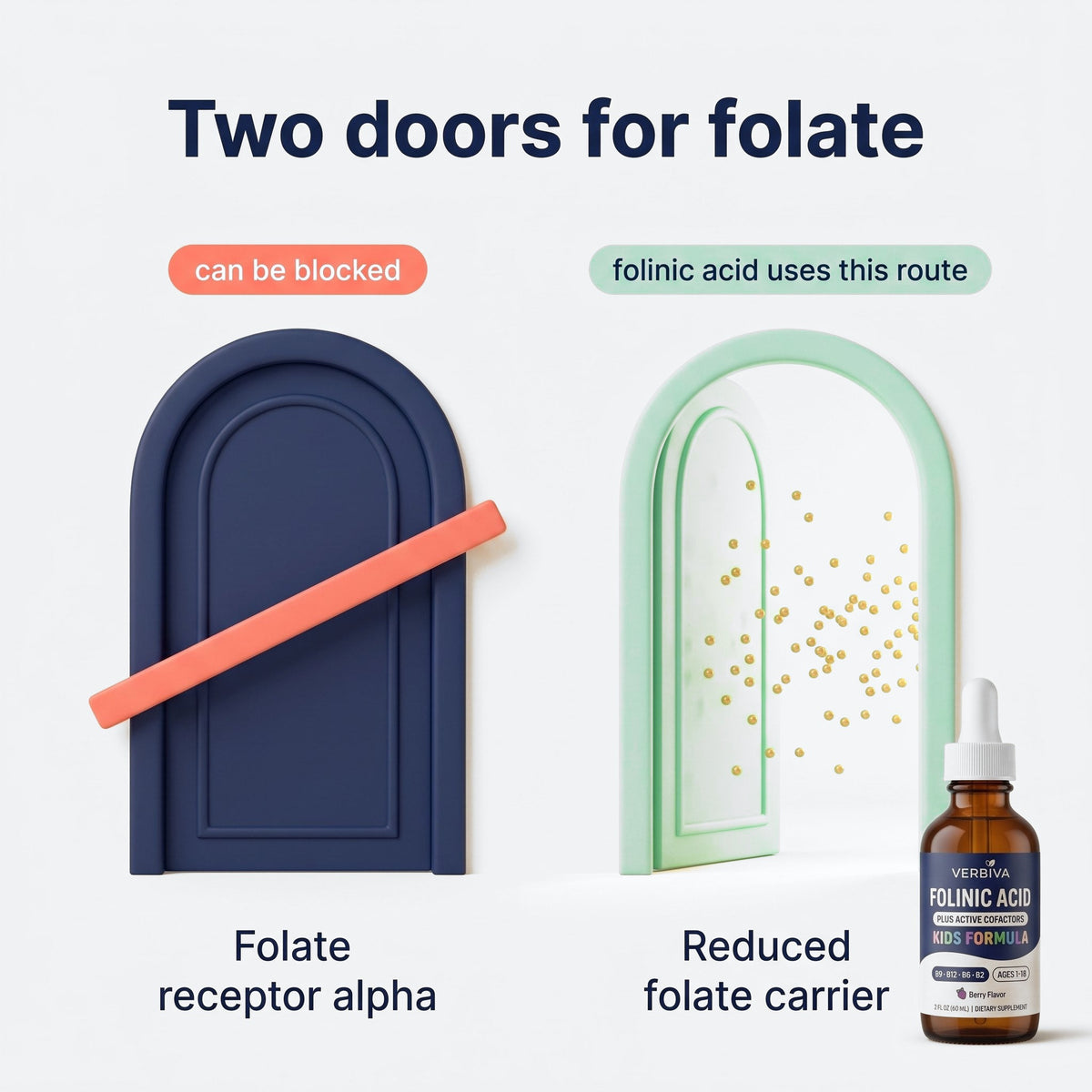
Folate is carried into the brain by folate receptor alpha. In some children, the immune system makes autoantibodies that block it – so blood folate can look normal while the brain gets too little.
A 2021 meta-analysis estimated these autoantibodies in about 71% of autistic children tested.
“Children with ASD were 19.03-fold more likely to be positive for a FRAA compared to typically developing children without an ASD sibling.”
Rossignol & Frye · Journal of Personalized Medicine, 2021 · systematic review and meta-analysis· Read the study ↗
Pediatric neurologists at University Hospital Aachen found blocking autoantibodies in 25 of 28 children with cerebral folate deficiency – and in none of 28 healthy controls.
“Oral folinic acid normalized 5MTHF levels in the cerebrospinal fluid and led to clinical improvement.”
Ramaekers et al. · New England Journal of Medicine, 2005· Read the study ↗
Children with autism and language impairment took folinic acid or a placebo for 12 weeks at Arkansas Children’s Hospital. Those on folinic acid improved more in verbal communication. The authors called it a small trial and asked for larger studies.
“There was no significant difference in adverse effects between treatment groups.”
Frye et al. · Molecular Psychiatry, 2018 · randomized, double-blind, placebo-controlled· Read the study ↗
The 2018 trial used prescription-strength folinic acid (leucovorin): 2 mg per kg of body weight a day, up to 50 mg, under a doctor’s care. Verbiva is a daily nutritional dose – 170 to 510 mcg DFE of folate as folinic acid, by age – with active B12, B6 and B2.
No over-the-counter drop matches the trial dose, and we won’t pretend otherwise. If you’re considering high-dose folinic acid, talk to your child’s doctor.
Quotes come from published studies of folinic acid (leucovorin). They describe the research, not Verbiva itself.
Verbiva is designed to support your child’s brain development over time. Stay consistent with the daily drops, follow the dosing schedule, and let the biology do what it was always meant to do – week by week.
Covered by our 90-day money-back guarantee – the full 12 weeks, and more.
Read the label
We read the labels so you don’t have to. Here’s how Verbiva compares with ordinary kids’ vitamins.
 Verbiva
Based on common kids’ multivitamin labels. Always check the Supplement Facts of the product you use.
Published research
Peer-reviewed studies on folate, the brain and folinic acid. Tap any card to read the full breakdown.
New England Journal of Medicine2005
The discovery
Blocking autoantibodies in 25 of 28 children with low brain folate – and in none of 28 healthy controls. Oral folinic acid normalized brain folate and led to clinical improvement.
Ramaekers et al.Read the study ↗
Molecular Psychiatry2013
Clinical study
Autoantibodies in 75% of 93 autistic children. Children treated with folinic acid improved more than a wait-list group in verbal communication, language, attention and repetitive behavior.
Frye et al.Read the study ↗
Molecular Psychiatry2018
Randomized controlled trial
48 children, 12 weeks, double-blind against placebo: verbal communication improved more on folinic acid – most of all in children positive for the autoantibodies.
Frye et al.Read the study ↗
Journal of Personalized Medicine2021
Meta-analysis
21 treatment studies reviewed: autoantibodies in 71% of autistic children, 19 times more often than in typical peers. Folinic acid improved communication, with mostly mild side effects.
Rossignol & FryeRead the study ↗
These studies used prescription folinic acid (leucovorin), mostly at higher doses than a daily supplement and under medical care. They describe the research, not Verbiva itself.
Vincent T. Ramaekers, Sheldon P. Rothenberg, Jeffrey M. Sequeira, Thomas Opladen, Nenad Blau, Edward V. Quadros, Jacob Selhub
Division of Pediatric Neurology, University Hospital Aachen, Germany
Some children have plenty of folate in their blood, yet almost none of it reaches the brain. This study found out why.
Key points
Folate is a B vitamin the brain needs to grow, build connections and make its chemical messengers. It reaches the brain through a doorway called the folate receptor alpha, which sits in the choroid plexus, the tissue that makes the fluid around the brain and spinal cord.
Doctors had already described a puzzling condition called cerebral folate deficiency. Blood tests showed normal folate, yet the fluid around the brain held very little of it. Nobody knew what was blocking the way.
The team tested blood samples from four groups:
They looked for antibodies that latch onto the folate receptor and stop folate from binding to it. The children with the condition were treated with folinic acid by mouth, and folate in the fluid around the brain was measured again.
25 of the 28 children with cerebral folate deficiency had high-affinity antibodies that block the folate receptor. None of the 28 healthy children had them.
After the children took folinic acid by mouth, folate in the fluid around the brain returned to normal and their symptoms improved.
This was the first study to show why folate can be missing in the brain while blood tests look fine: the body's own antibodies can block the doorway. It also showed that folinic acid can still get folate where it needs to go.
Later research found the same antibodies in many autistic children. That is why the folinic acid story starts with this paper.
This was a small study of children with a specific diagnosed condition, not a study of autism itself. The folinic acid was prescribed and given under medical care. The paper explained the mechanism; the autism studies came later.
Reference
Ramaekers VT, Rothenberg SP, Sequeira JM, Opladen T, Blau N, Quadros EV, Selhub J. Autoantibodies to folate receptors in the cerebral folate deficiency syndrome. N Engl J Med. 2005;352(19):1985-1991.
These studies used prescription folinic acid (leucovorin), mostly at higher doses than a daily supplement and under medical care. They describe the research, not Verbiva itself.
Richard E. Frye, Jeffrey M. Sequeira, Edward V. Quadros, S. Jill James, Daniel A. Rossignol
Arkansas Children's Hospital Research Institute, University of Arkansas for Medical Sciences, Little Rock, USA
After the 2005 discovery, researchers asked the next question: how common are these antibodies in autism, and do children who have them respond to folinic acid?
Key points
The 2005 discovery showed that antibodies can stop folate from reaching the brain. Doctors had also noticed autism-like symptoms in some children with cerebral folate deficiency, and reports of improvement with folinic acid. But nobody had checked how common the antibodies are in autism, or how antibody-positive children respond to treatment.
93 children with autism (84 boys and 9 girls, average age about 7) had a blood test for two kinds of folate receptor antibodies: blocking antibodies, which stop folate from attaching to the receptor, and binding antibodies, which stick to it.
16 children also had a spinal fluid test to measure folate around the brain.
44 antibody-positive children were treated with folinic acid (2 mg per kg of body weight per day, up to 50 mg, in two doses). 26 antibody-positive children who were still waiting for test results formed the comparison group. Parents rated changes over an average of about 4 months.
The antibodies are not rare in autism. They are common. And children who have them can respond to folinic acid, especially in language and communication. This study set the stage for the placebo-controlled trial that followed.
This was not a blinded trial. Parents knew whether their child was treated, the comparison group did not get a placebo, and the results were based on parent ratings. The children came from specialist clinics, so they may not represent every autistic child. The authors called for double-blind, placebo-controlled studies, which came next.
Reference
Frye RE, Sequeira JM, Quadros EV, James SJ, Rossignol DA. Cerebral folate receptor autoantibodies in autism spectrum disorder. Mol Psychiatry. 2013;18(3):369-381.
These studies used prescription folinic acid (leucovorin), mostly at higher doses than a daily supplement and under medical care. They describe the research, not Verbiva itself.
R. E. Frye, J. Slattery, L. Delhey, B. Furgerson, T. Strickland, M. Tippett, A. Sailey, R. Wynne, S. Rose, S. Melnyk, S. Jill James, J. M. Sequeira, E. V. Quadros
Arkansas Children's Research Institute, Little Rock, USA
The gold-standard test. Half the children got folinic acid, half got a look-alike placebo, and nobody, not the families and not the researchers, knew who got which.
Key points
Earlier studies looked promising, but parents and doctors knew who was being treated, and in autism research hope alone can make results look better than they are. To find out whether folinic acid really helps, the team ran a randomized, double-blind, placebo-controlled trial, the strongest kind of study in medicine.
This is the strongest evidence so far that folinic acid can help language in autistic children: measured by trained examiners, against placebo. It also suggests the folate receptor antibody test can help predict which children are most likely to respond.
The trial was small (48 children), ran at one center and lasted 12 weeks. The authors call the results preliminary until larger, longer studies at several centers confirm them; such trials were underway by 2021. The children took prescription folinic acid at a high dose under medical supervision.
Reference
Frye RE, Slattery J, Delhey L, et al. Folinic acid improves verbal communication in children with autism and language impairment: a randomized double-blind placebo-controlled trial. Mol Psychiatry. 2018;23(2):247-256.
These studies used prescription folinic acid (leucovorin), mostly at higher doses than a daily supplement and under medical care. They describe the research, not Verbiva itself.
Daniel A. Rossignol, Richard E. Frye
Rossignol Medical Center, Aliso Viejo, California; Barrow Neurological Institute at Phoenix Children's Hospital, Arizona, USA
Twenty years of research, pooled together: how common the antibodies are in autism, and what 21 treatment studies found.
Key points
By 2021 there were dozens of studies on folate receptor antibodies and folinic acid in autism: some small, some controlled, some single case reports. A systematic review gathers every relevant study using fixed rules. A meta-analysis then combines their numbers to give a clearer overall picture than any single study can.
The authors searched six research databases, including PubMed, Embase and Scopus, for every study up to September 2021 that measured folate receptor antibodies in autism or treated autistic children with folinic acid (leucovorin).
They pooled the results on how often the antibodies and low brain folate occur, and reviewed 21 treatment studies: four placebo-controlled, three prospective controlled, and the rest open-label studies and case reports.
The review concludes that folinic acid is an evidence-based treatment for autism with significant promise, that it appears safe and well tolerated, and that the antibodies may help identify the children most likely to benefit. Some children respond quickly, but the biggest gains can take one to two years.
Only a few of the studies were blinded and placebo-controlled, and several combined folinic acid with other supplements. The most common side effects reported were agitation (about 12%), aggression (about 10%), trouble sleeping (about 9%), more tantrums (about 6%) and headache (about 5%); in the placebo-controlled studies they were no more common than on placebo. Most studies used 0.5 to 2.5 mg per kg per day of prescription folinic acid.
Reference
Rossignol DA, Frye RE. Cerebral folate deficiency, folate receptor alpha autoantibodies and leucovorin (folinic acid) treatment in autism spectrum disorders: a systematic review and meta-analysis. J Pers Med. 2021;11(11):1141.
These studies used prescription folinic acid (leucovorin), mostly at higher doses than a daily supplement and under medical care. They describe the research, not Verbiva itself.
"My son hadn't said a word in over two years. Week 9 on Verbiva he walked into the kitchen and said mama. I stood there and didn't move for a full minute. I have never in my life been so grateful for a supplement."
"I was skeptical. I have tried every B vitamin on the market for three years. What made me try Verbiva was the mechanism — folinic acid bypassing the receptors made biological sense in a way nothing else ever had. Week 11 his speech therapist noticed without me saying anything. That was all I needed."
"My daughter was nonverbal for four years. Her therapist told me to focus on AAC. Eight weeks into Verbiva she said her sister's name. Her sister cried. I cried. The therapist asked what changed. Nothing changed except one supplement."
"Sleep improved first. Then eye contact. Then new sounds. Then words. That was the exact order every parent in the research thread described and it was the exact order it happened for my son. Week 10 he said more at dinner and pointed at his plate. I gave him more and went to the bathroom and cried."


Our promise
You’ve tried things before that didn’t work – and didn’t refund a cent. We do it differently. Give Verbiva 90 days. If you’re not happy for any reason, email us and we’ll refund your order – even opened bottles. No return needed, no forms.
Questions
Straight answers about folinic acid, dosing, testing and your order.
Ask us anything about Verbiva, dosing or your order. We read every message.
Contact usFolinic acid (also called calcium folinate or leucovorin) is a reduced, active form of folate – vitamin B9. Unlike folic acid, it doesn’t need to be converted before the body can use it.
It’s the same molecule, but not the same dose. Prescription leucovorin is used at much higher doses under medical supervision. Verbiva is a daily nutritional dose with active B12, B6 and B2. If you’re considering high-dose folinic acid, talk to your child’s doctor.
Ages 1–3: 10 drops. Ages 4–13: 20 drops. Ages 14–18: 30 drops. Once a day, straight or mixed into a drink.
Plan on one bottle per month – that’s how our bundles are counted (30, 60, 120 or 180 days). Younger children use fewer drops, so a bottle often lasts longer.
The drops are lightly berry-flavored in a glycerin base. Most parents mix them into a little juice or water.
Every child is different and nobody can promise a result. Folate status builds over weeks, so give it a consistent 12 weeks and keep a short journal. If it isn’t right for you, the 90-day guarantee applies.
Please check with your child’s doctor or pharmacist first – especially with seizure medication or any prescription – and tell them about other folate or B-vitamin supplements.
Yes. Verbiva is USDA Organic certified, made in a GMP facility, and every batch is third-party tested, including for heavy metals. It is vegan, gluten-free, soy-free and non-GMO.
Folinic acid (from calcium folinate), vitamin B12 (methylcobalamin, adenosylcobalamin, hydroxocobalamin), vitamin B6 (P-5-P), riboflavin (R-5-P), organic vegetable glycerin, reverse osmosis water and organic berry flavor (organic acacia gum, natural flavors, citric acid).
Every order includes 5-Minute Bedtime Stories – short, calm stories written for autistic children and the parents who read to them. You’ll get the download link by email after your order.
Orders ship with tracking and usually arrive within 8–10 days. Shipping is $4.78 (UK £3.71 · Canada CA$7.17 · Australia A$8.01 · New Zealand NZ$10.76) – free when your order includes Kids Omega-3 (free with Buy 3, Get 3) or the AAC Talking Device.
Email us within 90 days of delivery and we’ll refund your order – even opened bottles, no return needed.
